Sample infrastructure of a typical airport. Larger airports usually contain more runways and terminals.

Airport distribution in 2008

Birds eye view of the Kolkata Airport Terminal 2
An
airport is an
aerodrome with extended facilities, mostly for commercial air transport.
[1][2]Airports often have facilities to store and maintain
aircraft, and a
control tower. An airport consists of a
landing area, which comprises an aerially accessible open space including at least one operationally active surface such as a
runway for a
plane to take off
[3] or a
helipad,
[4] and often includes adjacent utility buildings such as
control towers,
hangars[5]and
terminals. Larger airports may have
fixed-base operator services,
airport aprons,
taxiway bridges, air traffic control centres, passenger facilities such as restaurants and
lounges, and
emergency services.
Landside and airside areas[edit]
Airports are divided into landside and airside. Landside includes areas such as
check-in,
parking lots,
public transportrailway stations and access
roads. Airside includes all areas accessible to aircraft, including runways,
taxiways and
aprons/ramps. Passage between landside and airside is tightly controlled at all airports. To access airside, one must go through Security, and if applicable, Passport Control too. This applies to everyone, including staff.
Most major airports provide commercial outlets for products and services. Airports may also contain premium and VIP services. The premium and VIP services may include express
check-in and dedicated check-in counters. In addition to people, airports move cargo around the clock. Many large airports are located near
railway trunk routes.
Air traffic control presence[edit]

Commercial jets wait for the "7am hold" to pass before departing from
John Wayne Airport, Feb 14, 2015
The majority of the world's airports are
non-towered, with no
air traffic control presence. Busy airports have air traffic control (ATC) system. All airports use a
traffic pattern to assure smooth traffic flow between departing and arriving aircraft. There are a number of aids available to
pilots, though not all airports are equipped with them. Many airports have
lighting that help guide planes using the runways and taxiways at night or in
rain,
snow, or
fog. In the U.S. and Canada, the vast majority of airports, large and small, will either have some form of
automated airport weather station, a human observer or a combination of the two.
Air safety is an important concern in the operation of an airport, and airports often have their own safety services.
Terminology[edit]
In colloquial use, the terms
airport and
aerodrome are often interchanged. However, in general, the term
airport may imply or confer a certain stature upon the aviation facility that an
aerodrome may not have achieved. In some jurisdictions,
airport is a legal
term of art reserved exclusively for those
aerodromes certified or licensed as airports by the relevant
national aviation authority after meeting specified certification criteria or regulatory requirements.
[6]
That is to say, all airports are aerodromes, but not all
aerodromes are airports. In jurisdictions where there is no legal distinction between
aerodrome and
airport, which term to use in the name of an aerodrome may be a commercial decision.
Aerodrome is uncommon in the United States.
Infrastructure[edit]
Smaller or less-developed airports, which represent the vast majority, often have a single runway shorter than 1,000 m (3,300 ft). Larger airports for
airline flights generally have paved runways 2,000 m (6,600 ft) or longer. Many small airports have dirt,
grass, or
gravel runways, rather than
asphalt or
concrete.
In the United States, the minimum dimensions for dry, hard landing fields are defined by the
FAR Landing And Takeoff Field Lengths. These include considerations for safety margins during landing and takeoff. Heavier aircraft require longer runways.
As of 2009, the
CIA stated that there were approximately 44,000 "... airports or airfields recognizable from the air" around the world, including 15,095 in the US, the US having the most in the world.
[7][8]
Airport ownership and operation[edit]
In Canada, the federal authority, Transport Canada, divested itself of all but the remotest airports in 1999/2000. Now most airports in Canada are owned and operated by individual legal authorities or are municipally owned.
Many U.S. airports still lease part or all of their facilities to outside firms, who operate functions such as retail management and parking. In the U.S., all commercial airport runways are certified by the FAA
[9] under the
Code of Federal Regulations Title 14 Part 139, "Certification of Commercial Service Airports"
[10]but maintained by the local airport under the regulatory authority of the FAA.
Despite the reluctance to privatize airports in the US (despite the
FAA sponsoring a privatization program since 1996), the government-owned, contractor-operated (GOCO) arrangement is the standard for the operation of commercial airports in the rest of the world.
Airport structures[edit]
Terminal structures at Sheremetyevo International Airport
Airports are divided into landside and airside areas. Landside areas include
parking lots,
public transportation train stations and access
roads. Airside areas include all areas accessible to aircraft, including runways,
taxiways and
aprons. Access from landside areas to airside areas is tightly controlled at most airports. Passengers on commercial flights access airside areas through
terminals, where they can purchase tickets, clear
security check, or
claim luggage and board aircraft through
gates. The waiting areas which provide passenger access to aircraft are typically called concourses, although this term is often used interchangeably with terminal.
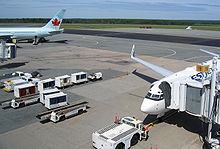
The apron from the top floor observation room, Halifax International Airport, Canada
The area where aircraft park next to a terminal to load passengers and baggage is known as a
ramp (or incorrectly, "the
tarmac"). Parking areas for aircraft away from terminals are called aprons.
Airports can be towered or
non-towered, depending on air traffic density and available funds. Due to their high capacity and busy
airspace, many
international airports have air traffic control located on site.
Airports with international flights have customs and
immigration facilities. However, as some countries have agreements that allow travel between them without customs and immigrations, such facilities are not a definitive need for an international airport. International flights often require a higher level of physical security, although in recent years, many countries have adopted the same level of security for international and domestic travel.
Some airport structures include on-site
hotels built within or attached to a terminal building. Airport hotels have grown popular due to their convenience for transient passengers and easy accessibility to the airport terminal. Many airport hotels also have agreements with airlines to provide overnight
lodging for displaced passengers.
Products and services[edit]
Most major airports provide commercial outlets for products and services. Most of these companies, many of which are internationally known brands, are located within the departure areas. These include clothing boutiques and restaurants and in the US amounted to $4.2 billion in 2015.
[14] Prices charged for items sold at these outlets are generally higher than those outside the airport. However, some airports now regulate costs to keep them comparable to "street prices". This term is misleading as prices often match the manufacturers'
suggested retail price(MSRP) but are almost never discounted.
[citation needed]
Apart from major fast food chains, some airport restaurants offer regional cuisine specialties for those in transit so that they may sample local food or culture without leaving the airport.
[15]
Major airports in such countries as Russia and Japan offer miniature sleeping units within the airport that are available for rent by the hour. The smallest type is the
capsule hotel popular in Japan. A slightly larger variety is known as a
sleep box. An even larger type is provided by the company
YOTEL.
Premium and VIP services[edit]
Airports may also contain premium and VIP services. The premium and VIP services may include express
check-in and dedicated check-in counters. These services are usually reserved for
First and
Business class passengers, premium
frequent flyers, and members of the airline's clubs. Premium services may sometimes be open to passengers who are members of a different airline's frequent flyer program. This can sometimes be part of a reciprocal deal, as when multiple airlines are part of the same alliance, or as a ploy to attract premium customers away from rival airlines.
Sometimes these premium services will be offered to a non-premium passenger if the airline has made a mistake in handling of the passenger, such as unreasonable delays or mishandling of checked baggage.
Airline lounges frequently offer free or reduced cost food, as well as alcoholic and non-alcoholic beverages. Lounges themselves typically have
seating, showers, quiet areas, televisions, computer,
Wi-Fi and Internet access, and power outlets that passengers may use for their electronic equipment. Some airline lounges employ
baristas, bartenders and gourmet chefs.
Airlines sometimes operate multiple lounges within the one airport terminal allowing ultra-premium customers, such as first class customers, additional services, which are not available to other premium customers. Multiple lounges may also prevent overcrowding of the lounge facilities.
Cargo and freight service[edit]
In addition to people, airports move cargo around the clock.
Cargo airlines often have their own on-site and adjacent infrastructure to transfer parcels between ground and air.
Cargo Terminal Facilities are areas where international airports export cargo has to be stored after customs clearance and prior to loading on the aircraft. Similarly import cargo that is offloaded needs to be in bond before the consignee decides to take delivery. Areas have to be kept aside for examination of export and import cargo by the airport authorities. Designated areas or sheds may be given to airlines or freight forward ring agencies.
Every cargo terminal has a landside and an airside. The landside is where the exporters and importers through either their agents or by themselves deliver or collect shipments while the airside is where loads are moved to or from the aircraft. In addition cargo terminals are divided into distinct areas – export, import and interline or transshipment.
Support services[edit]
In the USA, aircraft and passenger Boarding Bridges Maintenance, Pilot Operations, Commissioning, Training Services, aircraft rental, and hangar rental are most often performed by a fixed-base operator (FBO). At major airports, particularly those used as
hubs, airlines may operate their own support facilities.
Some airports, typically military airbases, have long runways used as
emergency landing sites. Many airbases have arresting equipment for fast aircraft, known as
arresting gear – a strong cable suspended just above the runway and attached to a hydraulic
reduction gear mechanism. Together with the landing aircraft's
arresting hook, it is used in situations where the aircraft's
brakes would be insufficient by themselves.
Airport access[edit]
Internal transport[edit]
The distances passengers need to move within a large airport can be substantial. It is common for airports to provide
moving walkways and buses. In 2007,
ThyssenKrupp installed two high-speed walkways in Terminal 1 at
Toronto Pearson International Airport. They connect the international gates in the newly opened Pier F, located at one end of the pier, with the rest of the terminal. One walkway serves departing passengers travelling towards the gates and the other serves arriving passengers travelling towards the terminal. The
Hartsfield–Jackson Atlanta International Airport has a tram that takes people through the concourses and baggage claim. Major airports with more than one terminal offer inter-terminal transportation, such as
Mexico City International Airport, where the domestic building of Terminal 1 is connected by
Aerotrén to Terminal 2, on the other side of the airport.
History and development[edit]

The Kharkiv Airport in Sokolniki,
Ukraine (1924).
The earliest aircraft takeoff and landing sites were grassy fields.
[16] The plane could approach at any angle that provided a favorable wind direction. A slight improvement was the dirt-only field, which eliminated the drag from grass. However, these only functioned well in dry conditions. Later, concrete surfaces would allow landings regardless of meteorological conditions.
Hamburg Airport opened in January 1911, making it the oldest commercial airport in the world which is still in operation.
Bremen Airport opened in 1913 and remains in use, although it served as an American military field between 1945 and 1949.
Amsterdam Airport Schiphol opened on September 16, 1916, as a military airfield, but only accepted
civil aircraftfrom December 17, 1920, allowing
Sydney Airport in
Sydney, Australia—which started operations in January 1920—to claim to be one of the world's oldest continually operating commercial airports.
[18] Minneapolis-Saint Paul International Airport in
Minneapolis-Saint Paul,
Minnesota, opened in 1920 and has been in continuous commercial service since. It serves about 35,000,000 passengers each year and continues to expand, recently opening a new 11,000 foot (3,355 meter) runway. Of the airports constructed during this early period in aviation, it is one of the largest and busiest that is still currently operating.
Rome Ciampino Airport, opened 1916, is also a contender, as well as the
Don Mueang International Airportnear Bangkok, Thailand, which opened in 1914.
[19] Increased aircraft traffic during
World War I led to the construction of landing fields. Aircraft had to approach these from certain directions and this led to the development of aids for directing the approach and landing slope.
Following the war, some of these military airfields added civil facilities for handling passenger traffic. One of the earliest such fields was
Paris – Le Bourget Airport at
Le Bourget, near
Paris. The first airport to operate scheduled international commercial services was
Hounslow Heath Aerodrome in August 1919, but it was closed and supplanted by
Croydon Airport in March 1920.
[20] In 1922, the first permanent airport and commercial terminal solely for commercial aviation was opened at
Flughafen Devau near what was then
Königsberg, East Prussia. The airports of this era used a paved "apron", which permitted night flying as well as landing heavier aircraft.
The first lighting used on an airport was during the latter part of the 1920s; in the 1930s
approach lighting came into use. These indicated the proper direction and angle of descent. The colours and flash intervals of these lights became standardized under the
International Civil Aviation Organization (ICAO). In the 1940s, the slope-line approach system was introduced. This consisted of two rows of lights that formed a funnel indicating an aircraft's position on the
glideslope. Additional lights indicated incorrect altitude and direction.
After
World War II, airport design became more sophisticated. Passenger buildings were being grouped together in an island, with runways arranged in groups about the terminal. This arrangement permitted expansion of the facilities. But it also meant that passengers had to travel further to reach their plane.
An improvement in the landing field was the introduction of grooves in the concrete surface. These run perpendicular to the direction of the landing aircraft and serve to draw off excess water in rainy conditions that could build up in front of the plane's wheels.
Airport construction boomed during the 1960s with the increase in
jet aircraft traffic. Runways were extended out to 3,000 m (9,800 ft). The fields were constructed out of
reinforced concrete using a slip-form machine that produces a continual slab with no disruptions along the length. The early 1960s also saw the introduction of jet bridge systems to modern airport terminals, an innovation which eliminated outdoor passenger boarding. These systems became commonplace in the United States by the 1970s.
Airport designation and naming[edit]
Some airports have unofficial names, possibly so widely circulated that its official name is little used or even known.
[citation needed]
Airport security[edit]
Airport security normally requires baggage checks, metal screenings of individual persons, and rules against any object that could be used as a weapon. Since the
September 11 attacks and the Real ID Act of 2005, airport security has dramatically increased and got tighter and stricter than ever before.
Airport operations[edit]
Air traffic control[edit]
A "controlled" or "towered" aerodrome has an operating control tower that is responsible for overseeing the safe, orderly, and expeditious flow of air traffic. Pilots are required to maintain two-way radio communication with air traffic controllers, and to acknowledge and comply with their instructions. Nontowered airport have no operating control tower and therefore two-way radio communications are not required, though it is good operating practice for pilots to transmit their intentions on the airport's
common traffic advisory frequency (CTAF) for the benefit of other aircraft in the area. The CTAF may be a Universal Integrated Community (UNICOM), MULTICOM, Flight Service Station (FSS), or tower frequency.
The majority of the world's airports are
non-towered, with no
air traffic control presence. However, at particularly busy airports, or airports with other special requirements, there is an air traffic control (ATC) system whereby
controllers(usually ground-based) direct aircraft movements via
radio or other communications links. This coordinated oversight facilitates safety and speed in complex operations where traffic moves in all three dimensions. Air traffic control responsibilities at airports are usually divided into at least two main areas:
ground and
tower, though a single controller may work both stations. The busiest airports also have
clearance delivery,
apron control, and other specialized ATC stations.
Ground Control is responsible for directing all ground traffic in designated "
movement areas", except the traffic on runways. This includes planes, baggage trains,
snowplows, grass cutters, fuel trucks, stair trucks, airline food trucks, conveyor belt vehicles and other vehicles. Ground Control will instruct these vehicles on which taxiways to use, which runway they will use (in the case of planes), where they will park, and when it is safe to cross runways. When a plane is ready to takeoff it will stop short of the runway, at which point it will be turned over to
Tower Control. After a plane has landed, it will depart the runway and be returned to Ground Control.
Tower Control controls aircraft on the runway and in the
controlled airspace immediately surrounding the airport. Tower controllers may use
radar to locate an aircraft's position in three-dimensional space, or they may rely on pilot position reports and visual observation. They coordinate the sequencing of aircraft in the traffic pattern and direct aircraft on how to safely join and leave the circuit. Aircraft which are only passing through the airspace must also contact Tower Control in order to be sure that they remain clear of other traffic.
Traffic pattern[edit]
At all airports the use of a
traffic pattern (often called a
traffic circuit outside the U.S.) is possible. They may help to assure smooth traffic flow between departing and arriving aircraft. There is no technical need within modern aviation for performing this pattern,
provided there is no queue. And due to the so-called SLOT-times, the overall traffic planning tend to assure landing queues are avoided. If for instance an aircraft approaches runway 17 (which has a heading of approx. 170 degrees) from the north (coming from 360/0 degrees heading towards 180 degrees), the aircraft will land as fast as possible by just turning 10 degrees and follow the
glidepath, without orbit the runway for visual reasons, whenever this is possible. For smaller piston engined airplanes at smaller airfields without
ILS equipment, things are very different though.
Generally, this pattern is a circuit consisting of five "legs" that form a rectangle (two legs and the runway form one side, with the remaining legs forming three more sides). Each leg is named (see diagram), and ATC directs pilots on how to join and leave the circuit. Traffic patterns are flown at one specific altitude, usually 800 or 1,000 ft (244 or 305 m)
above ground level (AGL). Standard traffic patterns are
left-handed, meaning all turns are made to the left. One of the main reason for this is that pilots sit on the left side of the airplane, and a Left-hand patterns improves their visibility of the airport and pattern. Right-handed patterns do exist, usually because of obstacles such as a
mountain, or to reduce noise for local residents. The predetermined circuit helps traffic flow smoothly because all pilots know what to expect, and helps reduce the chance of a
mid-air collision.
At extremely large airports, a circuit is in place but not usually used. Rather, aircraft (usually only commercial with long routes) request approach clearance while they are still hours away from the airport, often before they even take off from their departure point. Large airports have a frequency called Clearance Deliverywhich is used by departing aircraft specifically for this purpose. This then allows aircraft to take the most direct approach path to the runway and land without worrying about interference from other aircraft. While this system keeps the airspace free and is simpler for pilots, it requires detailed knowledge of how aircraft are planning to use the airport ahead of time and is therefore only possible with large commercial airliners on pre-scheduled flights. The system has recently become so advanced that controllers can predict whether an aircraft will be delayed on landing before it even takes off; that aircraft can then be delayed on the ground, rather than wasting expensive fuel waiting in the air.
Navigational aids[edit]
There are a number of aids available to pilots, though not all airports are equipped with them. A
visual approach slope indicator (VASI) helps pilots fly the approach for landing. Some airports are equipped with a
VHF omnidirectional range(VOR) to help pilots find the direction to the airport. VORs are often accompanied by a
distance measuring equipment(DME) to determine the distance to the VOR. VORs are also located off airports, where they serve to provide airways for aircraft to navigate upon. In poor weather, pilots will use an instrument landing system (ILS) to find the runway and fly the correct approach, even if they cannot see the ground. The number of instrument approaches based on the use of the
Global Positioning System (GPS) is rapidly increasing and may eventually be the primary means for instrument landings.
Larger airports sometimes offer
precision approach radar (PAR), but these systems are more common at military air bases than civilian airports. The aircraft's horizontal and vertical movement is tracked via radar, and the controller tells the pilot his position relative to the
approach slope. Once the pilots can see the runway lights, they may continue with a visual landing.
Taxiway signs[edit]
Airport guidance signs provide direction and information to taxiing aircraft and airport vehicles. Smaller aerodromes may have few or no signs, relying instead on diagrams and charts.
Lighting[edit]
Many airports have
lighting that help guide planes using the runways and taxiways at night or in rain or
fog.
On runways, green lights indicate the beginning of the runway for landing, while red lights indicate the end of the runway.
Runway edge lighting consists of white lights spaced out on both sides of the runway, indicating the edge. Some airports have more complicated lighting on the runways including lights that run down the centerline of the runway and lights that help indicate the approach (an
approach lighting system, or ALS). Low-traffic airports may use
pilot controlled lighting to save electricity and staffing costs.
Along taxiways, blue lights indicate the taxiway's edge, and some airports have embedded green lights that indicate the centerline.
Airport Apron[edit]
Both shielded and unshielded cable are listed in the specifications for the power cables on an airport apron ramp.
[21][22]
Weather observations[edit]
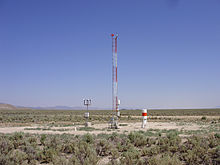
An automated weather system.
Weather observations at the airport are crucial to safe takeoffs and landings. In the US and Canada, the vast majority of airports, large and small, will either have some form of
automated airport weather station, whether an AWOS, ASOS, or AWSS, a human observer or a combination of the two. These weather observations, predominantly in the
METAR format, are available over the radio, through
automatic terminal information service (ATIS), via the ATC or the
flight service station.
Planes take-off and land
into the wind in order to achieve maximum performance. Because pilots need instantaneous information during landing, a
windsock is also kept in view of the runway. Aviation windsocks are made with lightweight material, withstand strong winds and are lit up after dark or in foggy weather. Because visibility of windsocks is limited, often multiple glow-orange windsocks are placed on both sides of the runway.
[23]
Safety management[edit]

"FLF Panther" airport crash tender in
Germany
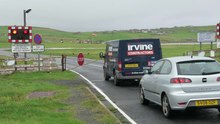
Road crossing of (
Shetland) A970 with
Sumburgh airport's runway. The movable barrier closes when aircraft land or take off.
Air safety is an important concern in the operation of an airport, and almost every airfield includes equipment and procedures for handling emergency situations.
Airport crash tender crews are equipped for dealing with airfield
accidents, crew and passenger extractions, and the hazards of highly flammable
aviation fuel. The crews are also trained to deal with situations such as
bomb threats,
hijacking, and
terrorist activities.
Hazards to aircraft include debris, nesting
birds, and reduced friction levels due to environmental conditions such as
ice,
snow, or
rain. Part of runway maintenance is
airfield rubber removal which helps maintain friction levels. The fields must be kept clear of debris using cleaning equipment so that loose material does not become a projectile and enter an engine duct (see
foreign object damage). In adverse weather conditions, ice and snow clearing equipment can be used to improve traction on the landing strip. For waiting aircraft, equipment is used to spray special
deicing fluids on the wings.
Many airports are built near open fields or
wetlands. These tend to attract bird populations, which can pose a hazard to aircraft in the form of
bird strikes. Airport crews often need to discourage birds from taking up residence.
Some airports are located next to parks, golf courses, or other low-density uses of land. Other airports are located near densely populated urban or suburban areas.
An airport can have areas where collisions between aircraft on the ground tend to occur. Records are kept of any
incursions where aircraft or vehicles are in an inappropriate location, allowing these "hot spots" to be identified. These locations then undergo special attention by transportation authorities (such as the FAA in the US) and airport administrators.
Some airfields now have a special surface known as soft concrete at the end of the runway (
stopway or blastpad) that behaves somewhat like
styrofoam, bringing the plane to a relatively rapid halt as the material disintegrates. These surfaces are useful when the runway is located next to a body of water or other hazard, and prevent the planes from overrunning the end of the field.
Airport ground crew (Ground Handling)[edit]
Most airports have
groundcrew handling the loading and unloading of passengers, crew, baggage and other services.
[citation needed] Some groundcrew are linked to specific airlines operating at the airport.
Many ground crew at the airport work at the aircraft. A tow tractor pulls the aircraft to one of the airbridges, The ground power unit is plugged in. It keeps the electricity running in the plane when it stands at the terminal. The engines are not working, therefore they do not generate the electricity, as they do in flight. The passengers disembark using the airbridge. Mobile stairs can give the ground crew more access to the aircraft's cabin. There is a cleaning service to clean the aircraft after the aircraft lands. Flight catering provides the food and drinks on flights. A toilet waste truck removes the human waste from the tank which holds the waste from the toilets in the aircraft. A water truck fills the water tanks of the aircraft. A fuel transfer vehicle transfers aviation fuel from fuel tanks underground, to the aircraft tanks. A tractor and its dollies bring in luggage from the terminal to the aircraft. They also carry luggage to the terminal if the aircraft has landed, and is being unloaded. Hi-loaders lift the heavy luggage containers to the gate of the cargo hold. The ground crew push the luggage containers into the hold. If it has landed, they rise, the ground crew push the luggage container on the hi-loader, which carries it down. The luggage container is then pushed on one of the tractors dollies. The conveyor, which is a conveyor belt on a truck, brings in the awkwardly shaped, or late luggage. The airbridge is used again by the new passengers to embark the aircraft. The tow tractor pushes the aircraft away from the terminal to a taxi area. The length of time an aircraft remains on the ground in between consecutive flights is known as "turnaround time". Airlines pay great attention to minimizing turnaround times in an effort to keep aircraft utilization (flying time) high, with times scheduled as low as 25 minutes for jet aircraft operated by low-cost carriers on narrow-body aircraft.
Environmental concerns and sustainability[edit]
Aircraft noise is a major cause of
noise disturbance to residents living near airports. Sleep can be affected if the airports operate night and early morning flights. Aircraft noise not only occurs from take-off and landings, but also ground operations including maintenance and testing of aircraft. Noise can have other
noise health effects. Other noise and environmental concerns are vehicle traffic causing noise and pollution on roads leading the airport.
[citation needed]
The construction of new airports or addition of runways to existing airports, is often resisted by local residents because of the effect on countryside, historical sites, local
flora and
fauna. Due to the risk of collision between birds and aircraft, large airports undertake population control programs where they frighten or shoot birds.
[citation needed]
The construction of airports has been known to change local
weather patterns. For example, because they often flatten out large areas, they can be susceptible to fog in areas where fog rarely forms. In addition, they generally replace
treesand grass with pavement, they often change
drainage patterns in
agricultural areas, leading to more
flooding, run-off and
erosion in the surrounding land.
[24][citation needed]
Some of the airport administrations prepare and publish annual
environmental reports in order to show how they consider these environmental concerns in airport management issues and how they protect environment from airport operations. These reports contain all
environmental protection measures performed by airport administration in terms of water, air, soil and noise pollution, resource conservation and protection of natural life around the airport.
The world's first airport to be fully powered by solar energy is located at
Kochi, India. Another airport known for considering environmental parameters is the
Seymour Airport at Galapagos Islands.
Military airbase[edit]
An airbase, sometimes referred to as an
air station or
airfield, provides basing and support of
military aircraft. Some airbases, known as
military airports, provide facilities similar to their civilian counterparts. For example,
RAF Brize Nortonin the UK has a terminal which caters to passengers for the
Royal Air Force's scheduled
TriStar flights to the
Falkland Islands. Some airbases are co-located with civilian airports, sharing the same ATC facilities, runways, taxiways and emergency services, but with separate terminals, parking areas and hangars.
Bardufoss Airport,
Bardufoss Air Station in Norway and
Pune Airport in India are examples of this.
An
aircraft carrier is a
warship that functions as a mobile airbase. Aircraft carriers allow a
naval force to project
air powerwithout having to depend on local bases for land-based aircraft. After their development in World War I, aircraft carriers replaced the
battleship as the centrepiece of a modern
fleet during World War II.
Airports in entertainment[edit]
Airports have played major roles in films and television programs due to their very nature as a transport and international hub, and sometimes because of distinctive architectural features of particular airports. One such example of this is
The Terminal, a film about a man who becomes permanently grounded in an airport terminal and must survive only on the food and shelter provided by the airport. They are also one of the major elements in movies such as
The V.I.P.s,
Airplane!,
Airport (1970),
Die Hard 2,
Soul Plane,
Jackie Brown,
Get Shorty,
Home Alone,
Liar Liar,
Passenger 57,
Final Destination (2000),
Unaccompanied Minors,
Catch Me If You Can,
Rendition and
The Langoliers. They have also played important parts in television series like
Lost,
The Amazing Race,
America's Next Top Model, Cycle 10 which have significant parts of their story set within airports. In other programmes and films, airports are merely indicative of journeys, e.g.
Good Will Hunting.
Several computer simulation games put the player in charge of an airport. These include the
Airport Tycoon series, SimAirport and Airport CEO.
Filming at airports[edit]
Most airports welcome filming on site, although it must be agreed in advance and may be subject to a fee. Landside, filming can take place in all public areas. However airside, filming is sometimes heavily restricted. To film in an airside location, all visitors must go through security, the same as passengers, and be accompanied by a full airside pass holder and have photographic identification with them at all times. Filming is strictly prohibited in security, immigration/customs and baggage reclaim.
Airport directories[edit]
Each national aviation authority has a source of information about airports in their country. This will contain information on airport elevation, airport lighting, runway information, communications facilities and frequencies, hours of operation, nearby
NAVAIDs and contact information where prior arrangement for landing is necessary.
- Information can be found on-line in the En route Supplement Australia (ERSA)[25] which is published by Airservices Australia, a government owned corporation charged with managing Australian ATC.
Infraero is responsible for the airports in Brazil
- Two publications, the Canada Flight Supplement (CFS) and the Water Aerodrome Supplement, published by NAV CANADA under the authority of Transport Canada provides equivalent information.
- The European Organisation for the Safety of Air Navigation (EUROCONTROL) provides an Aeronautical Information Publication (AIP), aeronautical chartsand NOTAM services for multiple European countries.
- Provided by the Luftfahrt-Bundesamt (Federal Office for Civil Aviation of Germany).
- Aviation Generale Delage edited by Delville and published by Breitling.
- The United Kingdom and Ireland
- The information is found in Pooley's Flight Guide, a publication compiled with the assistance of the United Kingdom Civil Aviation Authority (CAA). Pooley's also contains information on some continental European airports that are close to Great Britain. National Air Traffic Services, the UK's Air Navigation Service Provider, a public–private partnership also publishes an online AIP for the UK.
- The U.S. uses the Airport/Facility Directory (A/FD), published in seven volumes. DAFIF also includes extensive airport data but has been unavailable to the public at large since 2006.
- Aeronautical Information Publication (AIP)[26] is provided by Japan Aeronautical Information Service Center, under the authority of Japan Civil Aviation Bureau, Ministry of Land, Infrastructure, Transport and Tourism of Japan.
- A comprehensive, consumer/business directory of commercial airports in the world (primarily for airports as businesses, rather than for pilots) is organized by the trade group Airports Council International.
See also[edit]
Lists:
References[edit]
- Jump up^ Wragg, D.; Historical dictionary of aviation, History Press 2008.
- Jump up^ "Airport – Definition of airport by Merriam-Webster". Retrieved 1 September2015.
- Jump up^ "Runway – Definition of runway by Merriam-Webster". Retrieved 1 September 2015.
- Jump up^ "Helipad – Definition of helipad by Merriam-Webster". Retrieved 1 September 2015.
- Jump up^ "Hangar – Definition of hangar by Merriam-Webster". Retrieved 1 September2015.
- Jump up^ Canada Flight Supplement. Effective 0901Z 29 March 2018 to 0901Z 24 May 2018.
- Jump up^ "The World Factbook". Retrieved 1 September 2015.
- Jump up^ "The World Factbook". Retrieved 1 September 2015.
- Jump up^ "FAA". Retrieved 1 September 2015.
- Jump up^ "Part 139 Airport Certification". FAA. 2009-06-19. Archived from the original on 29 July 2010. Retrieved 2010-07-20.
- Jump up^ Anurag et al. General Design Procedures for Airport-Based Solar Photovoltaic Systems. Energies 2017, 10(8), 1194; doi:10.3390/en10081194
- Jump up^ https://www.solarpowerworldonline.com/2016/03/7-cool-solar-installations-at-u-s-airports/
- Jump up^ A. Kandt and R. Romero . Implementing Solar Technologies at Airports. NREL Report. Available: https://www.nrel.gov/docs/fy14osti/62349.pdf
- Jump up^ Gross, Daniel (7 September 2017). "Your Misery at the Airport Is Great for Business". Slate. Retrieved 8 September 2017.
- Jump up^ USA Today newspaper, Oct. 17, 2006, p. 2D
- Jump up^ Thomas, Andrew R. (2011-10-03). Soft Landing: Airline Industry Strategy, Service, and Safety. Apress. ISBN 9781430236771.
- Jump up^ "College Park Airport". Pgparks.com. Archived from the original on May 31, 2009. Retrieved 2010-07-20.
- Jump up^ "Sydney Airport history" (PDF). Archived from the original (PDF) on 2009-04-01. Retrieved 2010-07-20.
- Jump up^ Don Mueang International Airport
- Jump up^ Bluffield (2009)
- Jump up^ UNIFIED FACILITIES GUIDE SPECIFICATIONS, AIRFIELD LIGHTING
- Jump up^ Lightning Protection For Offshore Oil Installations. Arturo Galvan.
- Jump up^ "Why do airports have windsocks?". Piggotts Flags And Branding. Retrieved 29 March 2017.
- Jump up^ Sherry, Lance (2009). "Introduction to Airports Design and Operations"(PDF). George Mason University Center for Air Transportation Systems Research.
- Jump up^ "En route Supplement Australia (ERSA)". Airservices.gov.au. 2010-07-16. Retrieved 2010-07-20.
- Jump up^ "Aeronautical Information Publication (AIP), NOTAMs in Japan". Japan Civil Aviation Bureau. Archived from the original on 2011-07-22. Retrieved 2011-02-14.
- Bluffield, Robert. 2009. Imperial Airways – The Birth of the British Airline Industry 1914–1940. Ian Allan ISBN 978-1-906537-07-4
- Salter, Mark. 2008. Politics at the Airport. University of Minnesota Press. This book brings together leading scholars to examine how airports both shape and are shaped by current political, social, and economic conditions.
- Lopez, Donald S. "The inside Story Airports." Flight. Alexandria, VA: Time-Life, 1995. 36–37. Print.
External links[edit]
 | Look up airport in Wiktionary, the free dictionary. |
 | Wikimedia Commons has media related to Airport. |
 | Wikivoyage has a travel guide for airports. |


.jpg)


.jpg)


.jpg)